

Access by Storable
Building a unified access control platform from the ground up.
PROJECT SNAPSHOT
Role
Lead Designer
Platform
Embedded web app (desktop, within facility management software)
Team
Product Manager, Engineering team, Hardware/Integration partners
Problem
Fragmented, unreliable access control integrations created operational issues and were difficult to scale or maintain.
Solution
Built a unified access control platform as an embeddable micro frontend. Introduced automated “Access Zones” and simplified setup to reduce manual work and improve reliability.
Impact
201 facilities signed (first 6 months)
54% attach rate (vs. 33% target)
25+ new facilities/month
~$400K MRR potential (~$4.8M ARR)
Overview
Storable’s access control ecosystem was fragmented across multiple third-party integrations, each with inconsistent capabilities and high maintenance overhead.
I led design for a net-new, 0→1 product that unified these systems into a single, scalable platform—laying the foundation for future embedded services across Storable’s product suite.
Problem
Storable relied on multiple access control integrations across its facility management products.
This created:
Inconsistent experiences across products
Limited functionality depending on integration
Operational complexity for both customers and internal teams
Dependence on on-premise systems in some cases
Most critically, access failures disrupted facility operations. For operators, gate access is their “lifeblood.”
Opportunity
Design and launch a single, unified access control solution that could:
Replace fragmented integrations
Scale across all Storable products
Reduce long-term maintenance costs
Serve as a foundation for future platform services
We aligned on a system that combined:
A shared backend
An embeddable micro front end
A design system foundation for future reuse
Approach
0 → 1 Product Strategy
This was a true greenfield effort—no existing system, patterns, or shared UI foundation.
To de-risk and accelerate delivery, we:
Focused on SiteLink (largest customer base) for initial rollout
Defined a tight MVP scope based on highest-value use cases
Validated early and often with real operators
MVP Definition
Through internal analysis and competitive benchmarking, we identified core capabilities:
Instant access provisioning at move-in
Automatic lockout for delinquent or moved-out tenants
Access activity logs
Remote gate control
Group-based access tied to unit or tenant attributes
Research & Validation
I used rapid prototyping and customer feedback loops to shape the experience. Here’s what I learned:
Automation is critical
Unit-to-zone auto assignment saved time and reduced human error
Manual overrides raised security concerns
Reliability outweighs features
Hardware stability mattered more than feature depth
Access control is mission-critical to daily operations
Remote controls are secondary
Useful, but not frequent enough to prioritize in primary workflows
Design System & Platform Thinking
Because this was a 0→1 product, we also had to define how it would scale.
Key contributions
Designed Storable’s first reusable component library
Leveraged Bootstrap to accelerate development and reduce custom code
Established typography, color, and layout systems aligned to brand
Built a responsive framework adaptable across products
Impact
Enabled faster development across teams
Created consistency across the product ecosystem
Established a foundation for future embedded services
Solution
Minimum Lovable Product (MLP)
We delivered a centralized experience that allows operators to:
Monitor real-time access activity
Manage access points without losing context
Automatically assign units to access zones
Adjust tenant permissions and defaults
Filter and locate data quickly
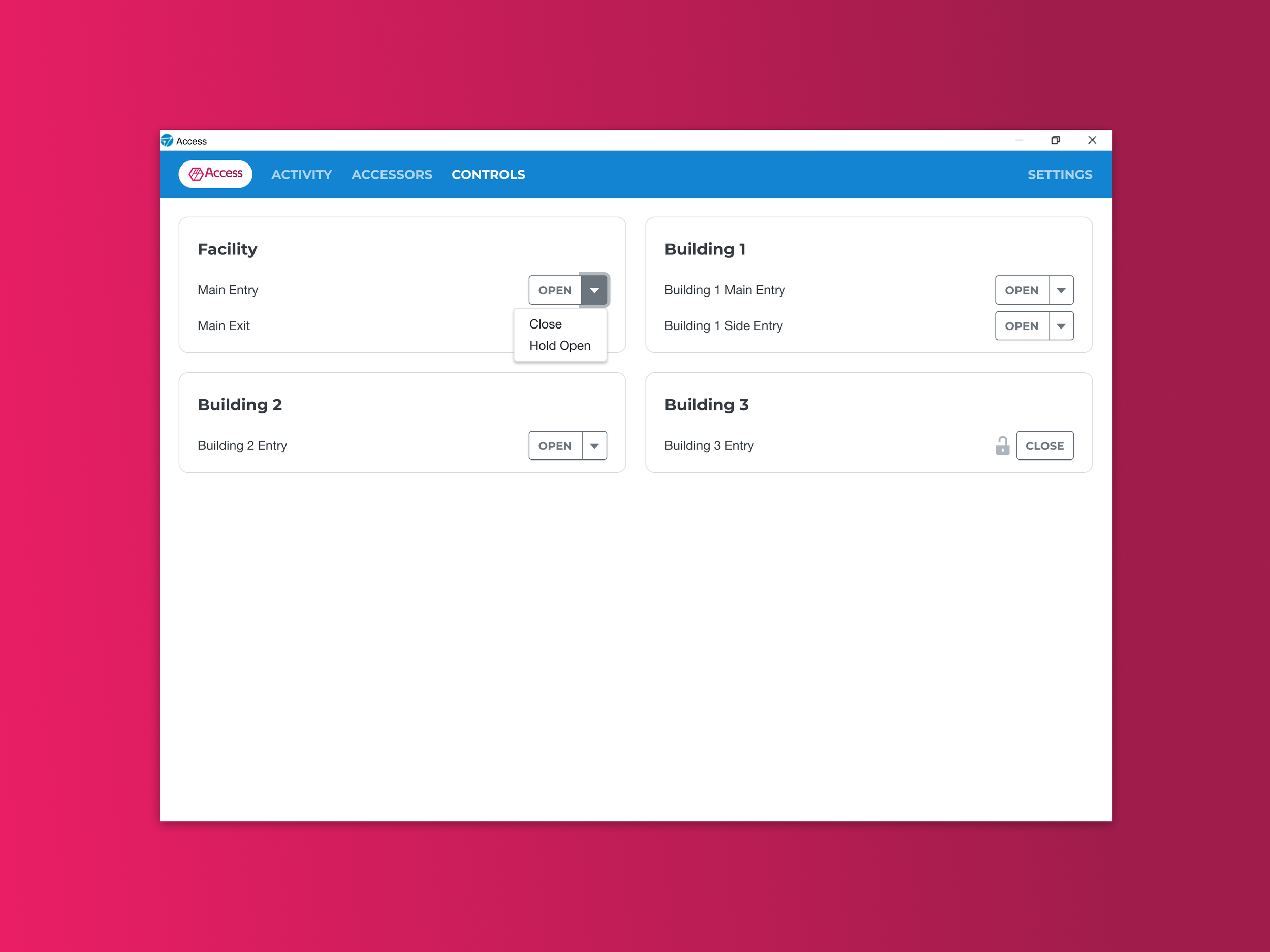
Remotely control gates when needed
The experience emphasized clarity, speed, and reliability—aligned to core user needs.
Impact
First 6 months:
201 facilities onboarded
$18K in monthly recurring revenue
Business impact:
Reduced reliance on multiple third-party integrations
Lowered support burden tied to access issues
Created a scalable platform for future products
Reflection
This work represented a shift from feature-based integrations → platform thinking.
By leading design on a 0→1 product, I:
Helped define a new product category within Storable
Introduced system-level thinking across teams
Established a foundation that extended beyond a single use case
PROBLEM
Storable has to support many different access control integrations for its facility management softwares.
“Access control” is a combination of hardware and software that manages tenant and non-tenant access privileges for a storage facility. Not only were Storable’s multiple integrations becoming hard to support, they were limited in capabilities, and some required using an on-premise computer. All these issues added up to frequent access-related issues for Storable customers and their tenants.
Learn how we solved this problem below, or skip to the shiny stuff.

OPPORTUNITY
A single access control solution that can integrate with all of Storable’s facility management softwares.
We focused our efforts on creating a resuable micro front end that could be embedded directly into any of our facility management softwares, while sharing a consolidated backend for easier maintenance.
MVP FEATURES IDENTIFIED THRU INTERNAL/COMPETITIVE ANALYSIS
Instantaneous access privileges when tenant is moved in
Automatic lock out when tenant is delinquent or moved out
Activity logs that capture access events
Remotely open, close, or hold open gates
Assign tenants to groups based on unit or tenant attributes
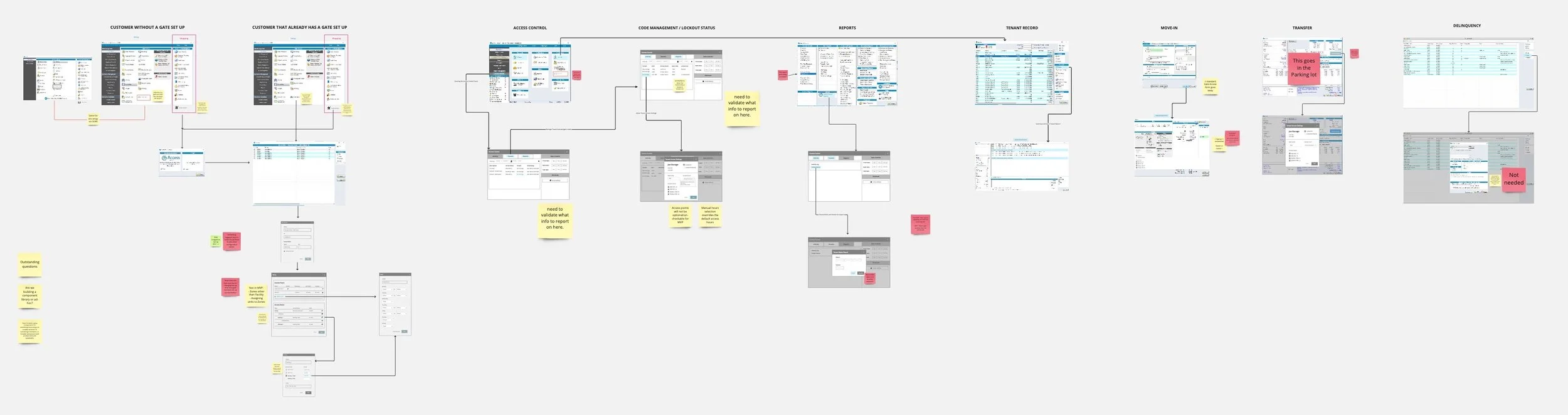
Our first iteration of Access was aimed at working with Storable’s most popular desktop facility management software, Sitelink, so that we could move faster and bring value to the most customers. This is one of many takes on the MVP user flow.
RESEARCH
Rethinking Access
We used customer feedback to inform our initial prototype then brought it back to potential users to validate the design. Below is sampling of what we heard and learned, some of which forced us to make small pivots in our architecture and user flows.
-
Saves time, prevents human error, and put Access over competitors.
-
Some operators had security concerns when access privileges can be manually assigned. Our MVP should focus on auto assignment.
-
The most important aspect for many customers is dependable hardware rather than specific features. The gate is their “lifeblood”.
-
Gates need to be opened manually sometimes, but not often, so pinned controls aren’t that helpful.
BEYOND MVP Needs SURVEY (weighted ranking)
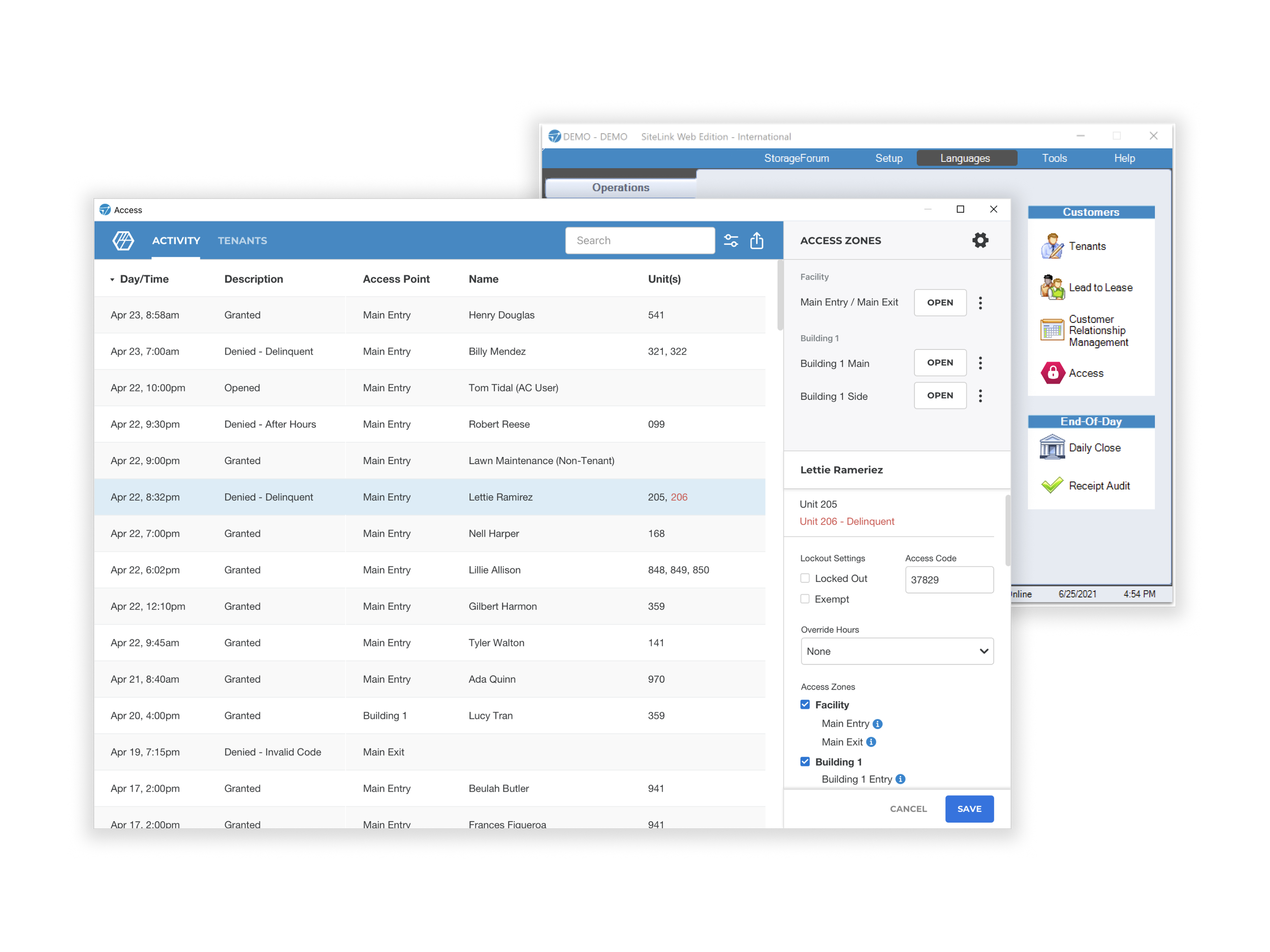
Early prototype used for customer validation
“You guys nailed it.”
“This is awesome.”
Beyond Access
The Access team was also laying the foundation for future embedded services by Storable, so we needed a system that could represent the new direction of the brand while working for the entire product portfolio. Using branding created by the marketing team, I mocked up several iterations to land on this scaleable approach.
Beyond branding, we were also creating Storable’s first component library that could be leveraged by other products. Since we had to move fast we decided to use an existing library as our base. We chose Bootstrap because it was already a popular framework at Storable and it included a robust and extendable set of utility classes that would help us avoid custom CSS. I used existing brand guidelines to inform the restyling of our components, as well created a comprehensive typography scale and UI color palette. I also utilized Bootstrap’s grid system to create a design that could flex to any screen size.
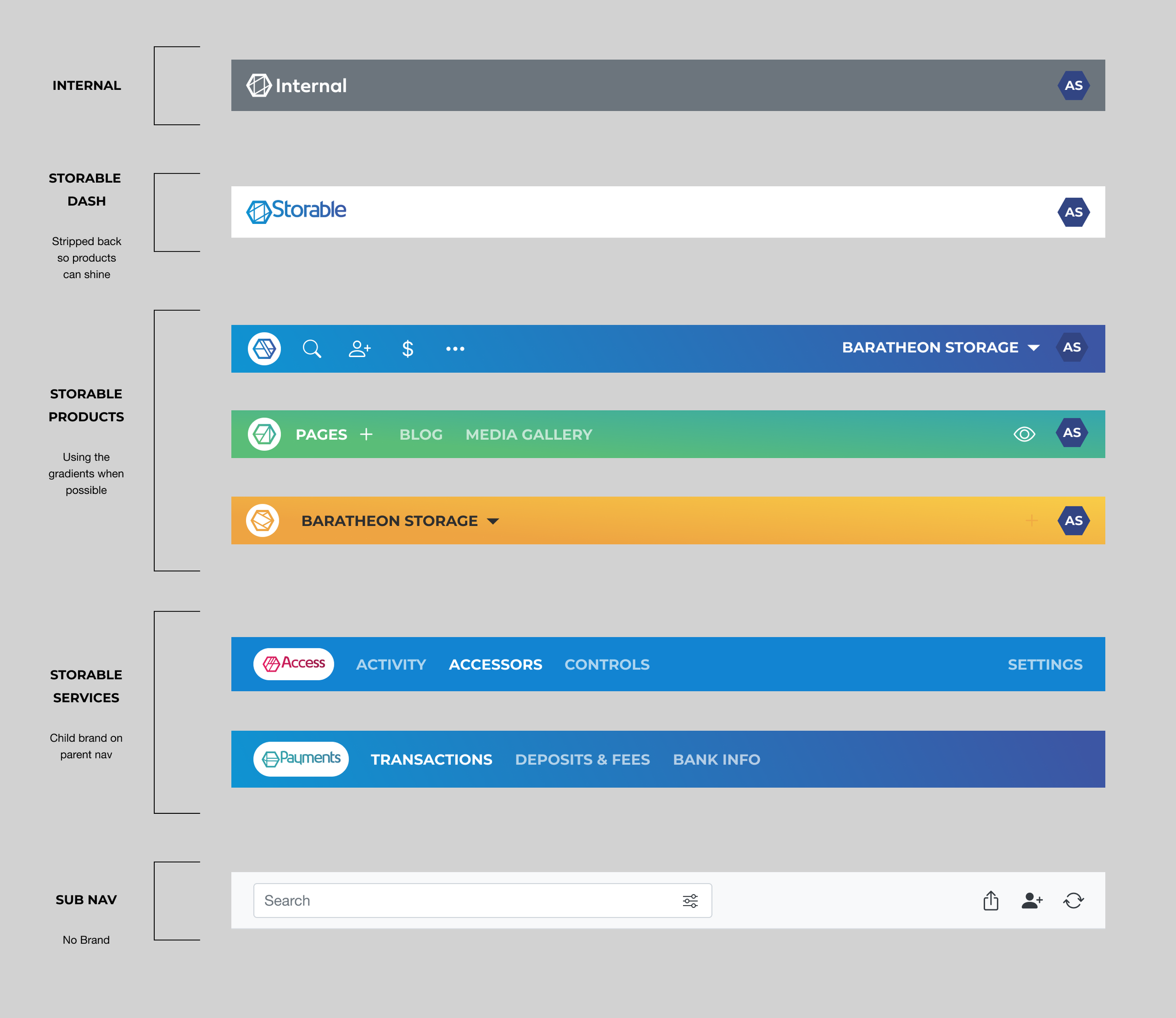

Responsive design considerations
WHAT WE DELIVERED
The MLP (minimum lovable product)
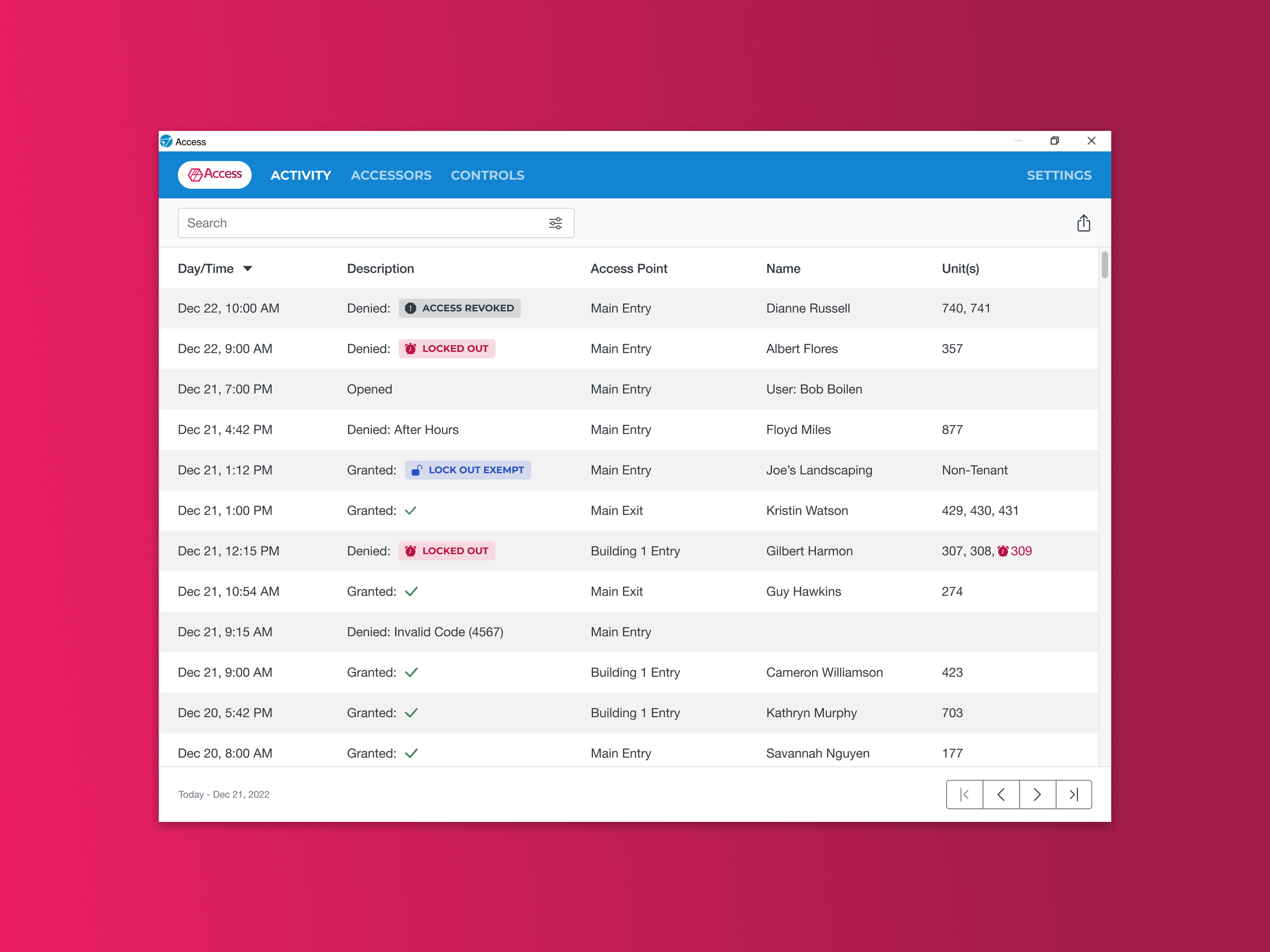
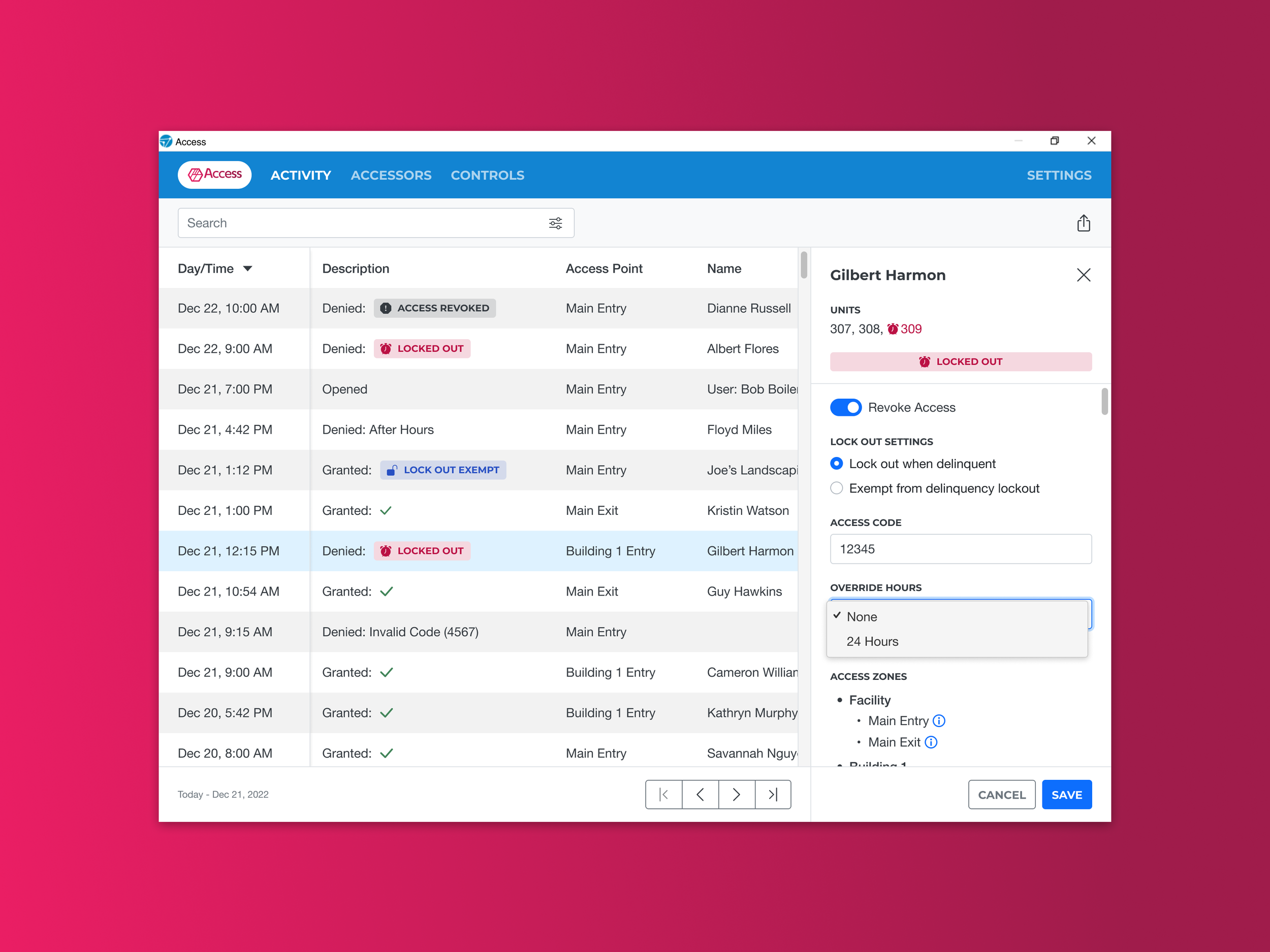
Access by Storable allows users to monitor access point activity and adjust privileges without losing context. Users can manage access points, assign units to access zones, and adjust settings and tenant defaults seamlessly. Advanced filters enable users to find specific entries and accessors quickly, while a robust filtering mechanism helps in refining results. Additionally, the system supports remote control of access points, providing a flexiblesolution for almost any access management need.




In the first 6 months
201 facilities signed = $18k Total MRR
plus untold cost savings to come from supporting a single solution!